
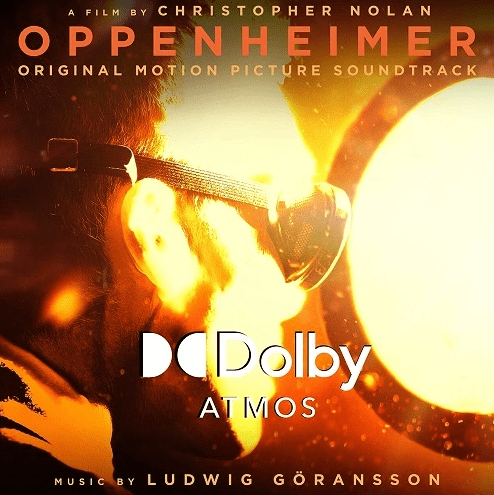
“Oppenheimer”, directed by Christopher Nolan and starring Cillian Murphy and Emily Blunt. The film’s score is composed by Ludwig Göransson, who previously worked with Christopher Nolan on “Tenet” in 2020.
The film’s soundtrack is presented in theaters in 5.(1) DTS, Dolby Digital or uncompressed digital sound.
Christopher Noland chose this 5.1 format to ensure the most similar sound reproduction possible in all cinemas.
The 2 versions tested here are : Amazon Music UltraHD and Tidal Dolby Atmos Music.
As the film is mixed in 5.1, the Dolby Atmos mix of the film’s music was created specifically for Dolby Atmos Music broadcast.
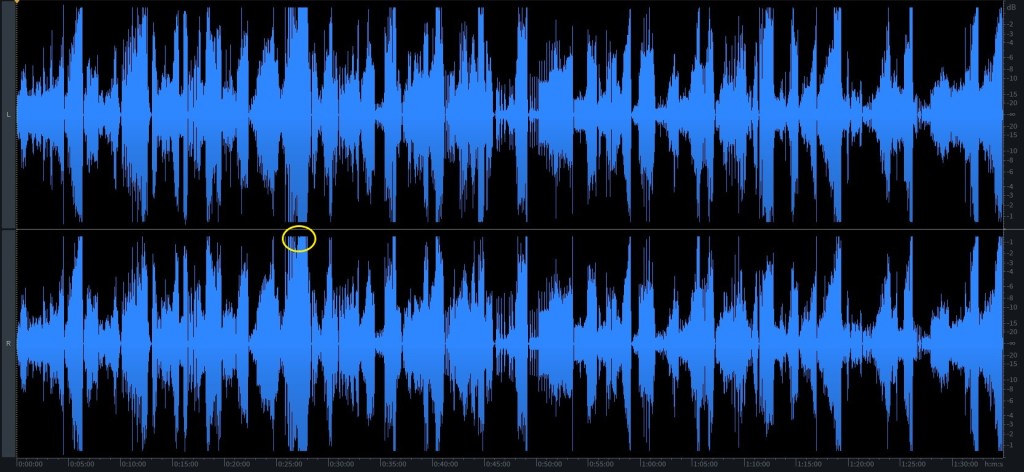
The waveform of Amazon Music’s digital stereo version is dynamic, but with areas showing the use of a dynamic limiter (yellow zone), which remains moderate as indicated by the average DR10 (DR13 for Dolby Atmos).
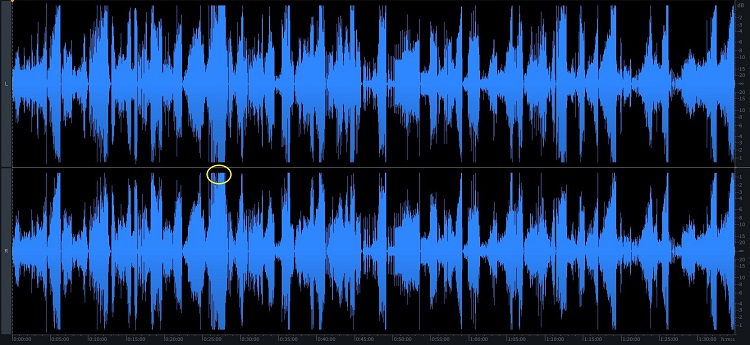
Waveform: Amazon Music UltraHD
The spectrum of the Amazon stereo version goes up to 24 kHz (white arrow), a limit due to the 48 kHz sampling frequency used. As with the Dolby Atmos version, there’s a high level of bass (30-40 Hz), as shown by the yellow arrow.
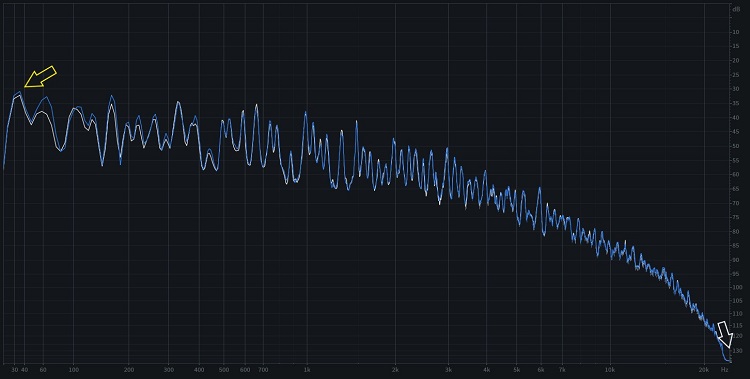
Spectrum: Amazon Music UltraHD
The Spatialization of the Dolby Atmos version varies greatly from track to track, with values ranging from 2.8 to 6.8. The spatialization of the tracks is very varied, and the rendering is designed to create the ambience of the film. Below is the average spatialization (all 24 tracks are detailed here)
Average spatialization
We appreciate the limited use of the dynamic limiter for this Oppenheimer soundtrack, unlike the Barbie stereo soundtrack.
So there are two ways to listen to this album in good quality: in stereo or in spatial sound, depending on your tastes and equipment.
You can find samples from the various media and all wavefom, spectra and spectrogram measurements here.
The film is presented on different supports in a variety of ratios:
- 70mm film ratio 2.20:1
- 70mm IMAX switches between the 2.20:1 and 1.43:1 aspect ratios throughout the film
- 35mm film, 2.35:1 anamorphic image
- IMAX digital : offer the film in 1.90:1 aspect ratio as well as 1.43:1 in select locations. Film switches between the 2.20:1 and 1.43:1 aspect ratios throughout the film
- 4K Digital Cinema : aspect ratio of 2.2:1
All these media feature a 5.(1) soundtrack, encoded differently depending on the medium:
- DTS for 70mm
- Dolby SR, Dolby Digital and DTS for the 35mm film
- IMAX Digital: uncompressed IMAX 5.0 sound mix of the film
- 4K Digital Cinema: uncompressed digital sound
Christopher Noland chose this 5.1 format to ensure the most similar sound reproduction possible in all cinemas.
For this review, you will find 2 versions tested: Amazon Music UltraHD and Tidal Dolby Atmos Music.
As the film is mixed in 5.1, the Dolby Atmos mix of the film’s music was created specifically for Dolby Atmos Music broadcast.
Below you will find the description of the different editions, as well as the measurements of each edition in the following chapters.
The synthesis of the review and the samples are available here
The album is composed of 24 tracks:
- Fission
- Can You Hear The Music
- A Lowly Shoe Salesman
- Quantum Mechanics
- Gravity Swallows Light
- Meeting Kitty
- Groves
- Manhattan Project
- American Prometheus
- Atmospheric Ignition
- Los Alamos
- Fusion
- Colonel Pash
- Theorists
- Ground Zero
- Trinity
- What We Have Done
- Power Stays In The Shadows
- The Trial
- Dr, Hill
- Kitty Comes To Testify
- Something More Important
- Destroyer Of Worlds
- Oppenheimer
First we will analyze each edition in detail (technical and qualitative analysis), then we will compare the successive editions with their dynamics and assign a final score, and you will be able to listen some samples.
The streaming versions may evolve over time, those presented here correspond to the version tested at the date of publication, or update of the review.
Part 1: presentation of the editions
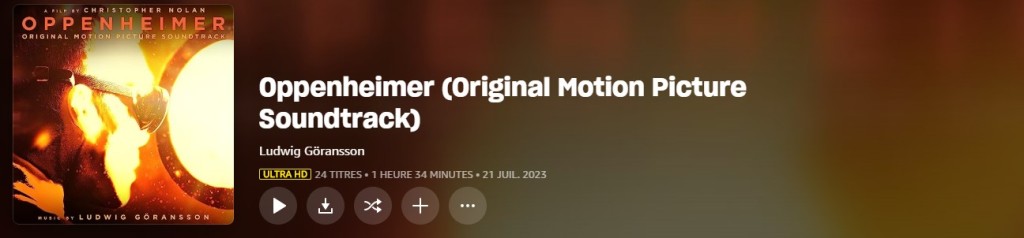
Ed 1: Amazon UltraHD – 2023
Presentation
The stereo version of Amazon Music is presented in UltraHD in 24 Bits 48 kHz.
Ed 2: Tidal Dolby Atmos – 2023
Presentation
The Tidal Dolby Atmos version is presented in Dolby Digital Plus 768 bits/s) or Dolby AC-4.
Part 2 : Waveform and dynamic comparisons
Waveform
The waveform represents tracks of this album.
The waveform of Amazon Music’s digital stereo version is dynamic, but with areas showing the use of a dynamic limiter (yellow zone), which remains moderate as shown by the average DR10.
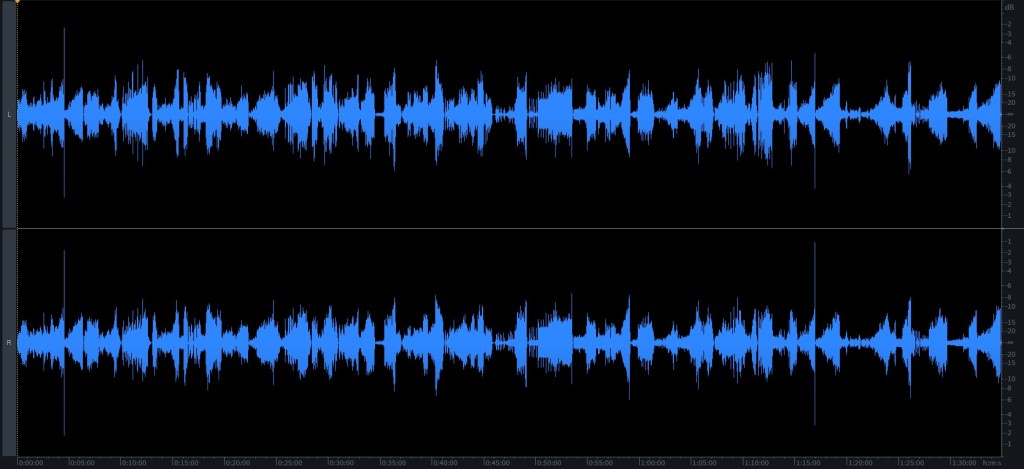
The waveform of the Dolby Atmos version, downmixed to stereo, shows a good dynamics, without the extreme use of limiters, unlike the digital stereo version (Ed2).
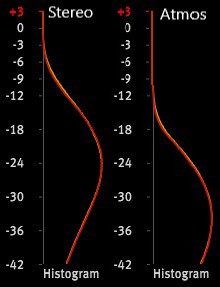
For this album, here’s a new measurement, the histogram, which complements the waveform measurements. The histogram shows the distribution of levels. The result is an interesting curve.
The histogram on the right shows the level distribution for the Dolby Atmos version (downmixed to stereo). The histogram on the left shows the level distribution for the Amazon stereo version. Between the two versions, the level distribution shifts upwards for the Amazon Stereo version. This translates into a higher sound level. As the effect of the limiter remains low, its impact is not shown on the curve.
Dynamic
Dynamic represents the ability to reproduce a wide range of sounds from the softest to the loudest. The target is to compare the dynamics of the music and not of the media (CD, digital files or vinyl).
For our 2 editions reviewed have obtained the following Dynamic Range (DR) :
| Amazon UltraHD – 2023 | Tidal Dolby Atmos – 2023 | |
| Global | DR10 | DR13 |
| Min | DR8 | DR11 |
| Max | DR12 | DR16 |
| Fission | DR12 | DR14 |
| Can You Hear The Music | DR9 | DR11 |
| A Lowly Shoe Salesman | DR11 | DR11 |
| Quantum Mechanics | DR9 | DR12 |
| Gravity Swallows Light | DR11 | DR12 |
| Meeting Kitty | DR11 | DR13 |
| Groves | DR11 | DR12 |
| Manhattan Project | DR7 | DR12 |
| American Prometheus | DR11 | DR12 |
| Atmospheric Ignition | DR11 | DR12 |
| Los Alamos | DR10 | DR13 |
| Fusion | DR9 | DR14 |
| Colonel Pash | DR11 | DR13 |
| Theorists | DR11 | DR14 |
| Ground Zero | DR11 | DR14 |
| Trinity | DR11 | DR14 |
| What We Have Done | DR11 | DR13 |
| Power Stays In The Shadows | DR12 | DR13 |
| The Trial | DR12 | DR16 |
| Dr, Hill | DR10 | DR12 |
| Kitty Comes To Testify | DR10 | DR15 |
| Something More Important | DR11 | DR12 |
| Destroyer Of Worlds | DR8 | DR14 |
| Oppenheimer | DR9 | DR12 |
The streaming stereo version (Amazon Music) has a lower dynamic range DR10 (between DR8 and DR10) than the Dolby Atmos version (DR13 in 7.1.4).
As a reminder, the scale goes from 0 to more 20, but the dynamics are considered good from 12, quite good between 10 and 11, and deteriorate below 10.
Part 3 : spectrum comparisons
Spectrum
The Spectrum allows to check the tonal balance of the music (balance between treble, medium and bass sounds) and to detect process that may have been carried out during the recording, the mixing, mastering or manufacturing phases. It is also possible to detect frequency interference issues.
The curve represents the average frequency distribution over a part of the track Can You Hear The Music.
The spectrum of the Amazon stereo version goes up to 24 kHz (white arrow), a limit due to the 48 kHz sampling frequency used. As with the Dolby Atmos version, there’s a high level of bass (30-40 Hz), as shown by the yellow arrow.

The spectrum of the Dolby Atmos Tidal version decoded in 5.1 shows the surround channels to be quite prominent in the extract shown. There’s a very high bass level in the front channels, particularly here around 30-40 Hz (yellow arrow). The bass channel is filtered at 120 Hz (green arrow). The white arrow indicates the high-frequency limit at 20 kHz, due to the Dolby Digital Plus encoding.

Part 4 : Spectrogram comparaisons
Spectrogram
Spectrogram is another representation of frequency versus time of a track. For each channel (right and left), horizontal axis represents time, and the vertical axis represents frequency. The amplitude is represented by the intensity (brightness) of the color of each point in the image.
The spectrogram of the Amazon stereo track is limited to 24kHz (yellow arrow) with no signal above (white arrow). This limitation is due to the 48kHz sampling frequency used for the UltraHD format of this album.

The spectrogram of the Dolby Atmos track downmixed in stereo is limited to 20kHz (yellow arrow) with no signal above (white arrow). This limitation is due to Dolby Digital Plus encoding, which is a lossy encoder that limits bandwidth to optimize data size for a bit rate of 768 kbits/s.

Part 5 : Spatialization
Spatialization allows you to define the sound distribution of the music on all the channels. The spatialization indicator and the description of the graph are described here.
Spatialization is available for Tidal Dolby Atmos .
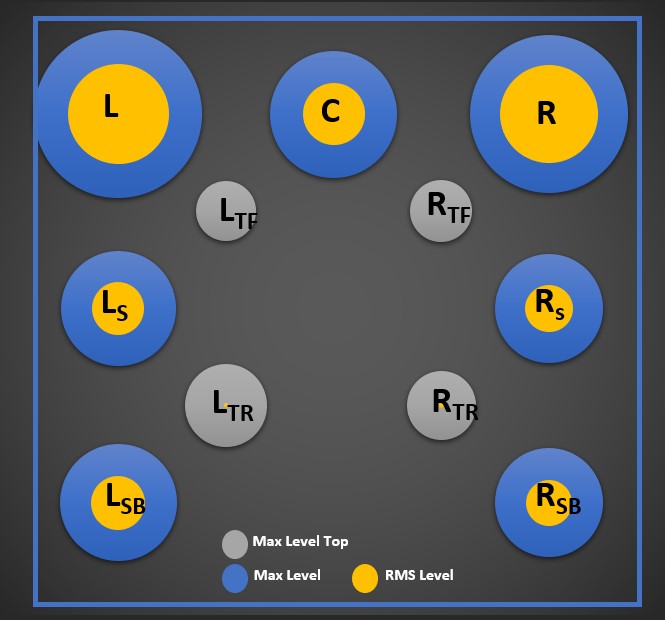
The Spatialization of the Dolby Atmos version varies greatly from track to track, with values ranging from 2.8 to 6.8. The spatialization of the tracks is very varied, and the rendering is designed to create the ambience of the film, with instruments distributed throughout the space on certain tracks.
Spatialization : ●●●●oooooo (4.1)
Below the spatialization for the 24 tracks of Tidal Dolby Atmos version. Click on the images to zoom in.

Part 6 : Summary, scoring and Samples
Ed 1: Amazon UltraHD – 2023
The pleasant surprise is that this digital stereo version has very little dynamic compression. The result is a beautiful sound image and a very precise rendering of the music. The music has a beautiful bass extension. The use of a lossless format for Amazon UltraHD, despite a lower dynamic range, provides a finer rendition than the Dolby Atmos version.
Rating:
- Dynamic: ●●●oo (3)
- Bandwidth: ●●●●o (4)
- Restitution: ●●●●o (4)
Sample : Can You Hear The Music 24 bits 48 kHz:Sample 1 Ed 1: Amazon UltraHD – 2023
Ed 2: Tidal Dolby Atmos – 2023
The Dolby Atmos version is a little more dynamic than the stereo version, with a spatial rendering that allows greater immersion in the film’s music and atmosphere. The punctual presence of bass in the LFE channel reinforces the impact of low frequencies.
Rating:
- Dynamic: ●●●●o (4)
- Bandwidth: ●●●●o (4)
- Spatialization: ●●●●oooooo (4.1)
- Restitution: ●●●●o (4)
Sample : Can You Hear The Music 5.1 (dolby Atmos downlixed in 5.1):
The sample is in 5.1 wav format, if you can not play the sample in your navigator, you can save it, right button menu and “Save Audio As…” and play it with an external player.Sample 1 Ed 2: Tidal Dolby Atmos – 2023
The stereo version provides a detailed, dynamic version that reproduces the atmosphere and immerses us in the film. We appreciate the limited use of the dynamic limiter for this Oppenheimer soundtrack, unlike the Barbie stereo soundtrack. The Dolby Atmos version offers a very successful, more spatial and immersive listening experience for this Oppenheimer soundtrack. So there are two ways to listen to this album in good quality: in stereo or in spatial sound, depending on your tastes and equipment.
Subscribe to MagicVinylDigital
Get new content delivered directly to your inbox.
Type your email…
Subscribe
Detail of the ratings :
- Dynamic :
- Significant dynamic compression, DR less than 7
- Compression of the present dynamics, DR between 7 and 9.
- Correct piece DR >=10
- No dynamic compression (DR >12), dynamic rendering
- No dynamic compression, high DR and very dynamic sound rendering
- Spectrum :
- Spectrum cut and less than 15 khz
- Spectrum cut at 15 khz
- Spectrum not conforming to the original and cut (not HD) or original but limited bandwidth (but less than 20 kHz)
- Spectrum conforming to the original (but not HD)
- Spectrum conforming to the original with HD resolution (higher than 24kHz)
- Surface noise (only for vinyl):
- Continuous audible noise
- Audible surface noise except on passages with a high level of noise
- Reduced surface noise, barely audible on low level crossings
- Low surface noise, very good quality
- Very low surface noise, no defects, almost inaudible on the quiet passages (exceptional disc)
- Spatialization :
- Between 0 and 5 for 5.1 or 7.1 channels configuration
- Between 0 and 10 for Atmos configuration (7.1.4)
- For more information on spatialization, you can read the article describing this parameter here.
- Restitution :
- Low quality of the restitution mixing dynamics, clarity, separation of voices and instruments.
- Average quality of the restitution mixing dynamics, clarity, separation of voices and instruments.
- Quality of the restitution mixing dynamics, clarity, separation of voices and instruments. Good record.
- High quality of the restitution mixing dynamics, clarity, separation of voices and instruments. Very high level disc.
- Maximum quality of the restitution mixing dynamics, clarity, separation of voices and instruments. Exceptional disc.
 Ivy Music